

Blended Learning
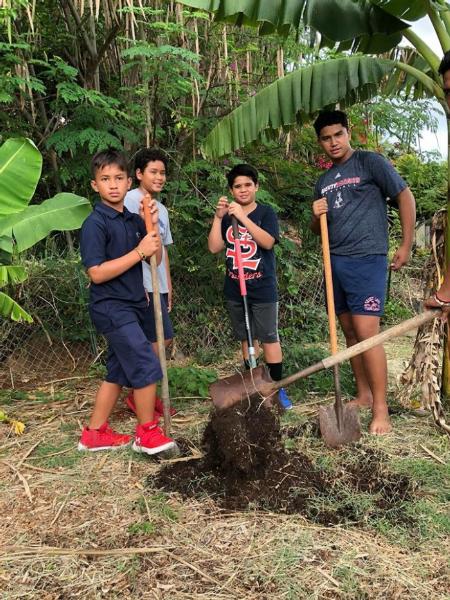



ʻĀINA BASED LEARNING
He welina mai kākou! Welcome!
There is man, and there is the environment. One does not supersede the other. Man is merely the caretaker of the land that maintains his life and nourishes his soul. The land is sacred. The church of life is not in a building, it is in the open sky, the surrounding ocean, and the beautiful soil. George J. Helm ’68
He welina mai kākou! Welcome!
O'ahu a Kākuhihewa is our reference to this island (mokupuni) where Saint Louis School rests in the moku, or district, of Kona located on the southeastern lee side of the Ko`olau facing Māmala bay. The Kona district on O’ahu includes the state capital of Honolulu, and therefore has become the urban concentration of finance, education, and commerce for Hawai‘i.
Our division of the moku is the ahupua'a of Pālolo, stretching from the windswept summits of Ka'auhelemoa and Awawaloa, descending by valley and ridgelines, down through former wetlands and out to the sea at Kalehuawehe off the famed shoreline of Waikīkī.
He ali‘i ka ‘āina, he kauwā ke kanaka.
The land is chief, the human is the servant. ‘ōlelo no‘eau
Why is ‘āina-based learning emphasized at Saint Louis School?
By knowing one’s place, and the people in that place, learning becomes relevant, rigorous, and relationship-oriented. Upon this foundation of knowledge and skills gained from Kalaepōhaku, a Saint Louis student will build. His building will not stop at our community of Kaimukī – Pālolo; he will use this launching point to see similar issues and parallels in his state, national, and eventually global community in which he dwells. Global stewardship becomes a guideline for the Saint Louis man to navigate and to improve his community.
‘Āina-based learning (ABL) is embedded—foundational—to Saint Louis School from its very establishment. At the core of our beginning as the College of Ahuimanu in 1846 was the education of Hawaiian men to become the educators tasked with the kuleana of bearing aloha ‘āina (leadership) into the future of the fledgling kingdom under King Kauikeaouli Kamehameha III. In a royal land grant in 1845, he provided over 200 acres to the Catholic Mission at the verdant vale of ‘Āhuimanu in He'eia for the establishment of a school to develop Native Hawaiian men into educators to minister to the indigenous youth. The language of instruction for the first eleven years of the College was 'olelo Hawai'i. ABL therefore complements our Catholic educational foundation as an indigenous means to achieving the mission of Saint Louis School. The values of this curricular theme resonate in the message of Pope Francis in his Encyclical Letter of Laudato Sí:
Ecology, then, also involves protecting the cultural treasures of humanity in the broadest sense. More specifically, it calls for greater attention to local cultures when studying environmental problems, favouring a dialogue between scientific-technical language and the language of the people. Culture is more than what we have inherited from the past; it is also, and above all, a living, dynamic and participatory present reality, which cannot be excluded as we rethink the relationship between human beings and the environment. 24 May 2015
(Image of text in the upper left column) Translation of a newspaper clipping just months following the overthrow of the Hawaiian Monarchy in 1893:
We were informed that the teachers of Saint Louis are teaching the students of that school about aloha ‘āina, because a person that has no love for his land of birth, that person is a beast.
Hawaii Holomua, Buke III, helu 16, Aoao 3. Aperila 15, 1893. www.nupepa-hawaii.com
A brief overview of our 175-year history: https://youtu.be/cxArHRXsTbk
ʻĀINA BASED LEARNING
He welina mai kākou! Welcome!
There is man, and there is the environment. One does not supersede the other. Man is merely the caretaker of the land that maintains his life and nourishes his soul. The land is sacred. The church of life is not in a building, it is in the open sky, the surrounding ocean, and the beautiful soil. George J. Helm ’68
He welina mai kākou! Welcome!
O'ahu a Kākuhihewa is our reference to this island (mokupuni) where Saint Louis School rests in the moku, or district, of Kona located on the southeastern lee side of the Ko`olau facing Māmala bay. The Kona district on O’ahu includes the state capital of Honolulu, and therefore has become the urban concentration of finance, education, and commerce for Hawai‘i.
Our division of the moku is the ahupua'a of Pālolo, stretching from the windswept summits of Ka'auhelemoa and Awawaloa, descending by valley and ridgelines, down through former wetlands and out to the sea at Kalehuawehe off the famed shoreline of Waikīkī.
He ali‘i ka ‘āina, he kauwā ke kanaka.
The land is chief, the human is the servant. ‘ōlelo no‘eau
Why is ‘āina-based learning emphasized at Saint Louis School?
By knowing one’s place, and the people in that place, learning becomes relevant, rigorous, and relationship-oriented. Upon this foundation of knowledge and skills gained from Kalaepōhaku, a Saint Louis student will build. His building will not stop at our community of Kaimukī – Pālolo; he will use this launching point to see similar issues and parallels in his state, national, and eventually global community in which he dwells. Global stewardship becomes a guideline for the Saint Louis man to navigate and to improve his community.
‘Āina-based learning (ABL) is embedded—foundational—to Saint Louis School from its very establishment. At the core of our beginning as the College of Ahuimanu in 1846 was the education of Hawaiian men to become the educators tasked with the kuleana of bearing aloha ‘āina (leadership) into the future of the fledgling kingdom under King Kauikeaouli Kamehameha III. In a royal land grant in 1845, he provided over 200 acres to the Catholic Mission at the verdant vale of ‘Āhuimanu in He'eia for the establishment of a school to develop Native Hawaiian men into educators to minister to the indigenous youth. The language of instruction for the first eleven years of the College was 'olelo Hawai'i. ABL therefore complements our Catholic educational foundation as an indigenous means to achieving the mission of Saint Louis School. The values of this curricular theme resonate in the message of Pope Francis in his Encyclical Letter of Laudato Sí:
Ecology, then, also involves protecting the cultural treasures of humanity in the broadest sense. More specifically, it calls for greater attention to local cultures when studying environmental problems, favouring a dialogue between scientific-technical language and the language of the people. Culture is more than what we have inherited from the past; it is also, and above all, a living, dynamic and participatory present reality, which cannot be excluded as we rethink the relationship between human beings and the environment. 24 May 2015
(Image of text in the upper left column) Translation of a newspaper clipping just months following the overthrow of the Hawaiian Monarchy in 1893:
We were informed that the teachers of Saint Louis are teaching the students of that school about aloha ‘āina, because a person that has no love for his land of birth, that person is a beast.
Hawaii Holomua, Buke III, helu 16, Aoao 3. Aperila 15, 1893. www.nupepa-hawaii.com